22 March 2008

6-word Meme-oir

I was tagged by Ivars of Ivars' Birds to participate in the six-word memoir meme. I thought and thought about how to whittle myself down to six words. As Mark Twain said "I can give you 3o pages in two days. I need 30 days to write two pages." So, as I tend to do a lot in my life, I will paraphrase The Simpsons:

"Nature embiggens even the smallest man."


So now I get to choose five more on this meme's way to conquering the universe. In fact, I think it's high time blogospheres collided, so I'll tag my wife Kellie at Cottage Knitting and send this meme into the knitting blogworld. And how can the other birders have missed Amila at Gallicissa? Are we so afraid of his Scrabble skills that we can't ask him to describe himself in 6 words? Oh, I see. He's out of town; I'm sure he'll have thirty of these waiting for him when he gets back from his tour. Fellow newbie birder and blogger BirdingGirl of BirdingGirl needs to show everyone what it's like to bird Mass and Cape Cod-style. Dan of Nervous Birds has been making sure Ram's Head in Annapolis hasn't gone out of business since I graduated, let's see if he can string six words together after a gig! Over at Hakodate Birding, S.C.E. supplies endless pictures of everyday (to him) exotic (to me) birds. Three words for birds, three for footy, which is what I assume he talks about at the end of his posts.

Okay guys, here's the rules:

>1. Write your own six word memoir
>2. Post it on your blog and include a visual illustration if you’d like
>3. Link to the person that tagged you in your post and to this original post if possible so we can track it as it travels across the blogosphere
>4 .Tag five more blogs with links
>5. And don’t forget to leave a comment on the tagged blogs with an invitation to play!

07 March 2008

William Butler Yeats


The Wild Swans at Coole

The trees are in their autumn beauty,
The woodland paths are dry,
Under the October twilight the water
Mirrors a still sky;
Upon the brimming water among the stones
Are nine-and-fifty swans.

The nineteenth autumn has come upon me
Since I first made my count;
I saw, before I had well finished,
All suddenly mount
And scatter wheeling in great broken rings
Upon their clamorous wings.

I have looked upon those brilliant creatures,
And now my heart is sore.
All's changed since I, hearing at twilight,
The first time on this shore,
The bell-beat of their wings above my head,
Trod with a lighter tread.

Unwearied still, lover by lover,
They paddle in the cold
Companionable streams or climb the air;
Their hearts have not grown old;
Passion or conquest, wander where they will,
Attend upon them still.

But now they drift on the still water,
Mysterious, beautiful;
Among what rushes will they build,
By what lake's edge or pool
Delight men's eyes when I awake some day
To find they have flown away?


Mute swans, since he's Irish. Photo from Wikimedia. Is it wrong that I don't really care for Yeats?

04 March 2008

Flo-ree-da!

Well, we just got back from a long weekend in Florida visiting the wife's family, including our new nephew Baby Joe. My brother-in-law and his wife were very kind in taking us out to a few local parks to let me do some birding and to get Baby Joe into nature. I've mentioned before how great Florida can be for the beginning birder. It's pretty dang good for the slightly more experienced birder as well. Here's the breakdown:

Life Birds: 14

Wild Turkey
Eared Grebe
Red-shouldered Hawk
Short-tailed Hawk
Common Moorhen
Caspian Tern
Royal Tern
Common Ground-dove
Pileated Woodpecker
Loggerhead Shrike
Blue-gray Gnatcatcher
Hermit Thrush
Prairie Warbler
Palm Warbler

Florida Life Birds (excluding above): 22

Ring-necked Duck
Lesser Scaup
Snowy Egret
Little Blue Heron
American Coot
American Oystercatcher
Ring-billed Gull
Red-bellied Woodpecker
Yellow-bellied Sapsucker
Blue Jay
American Crow
Tree Swallow
Carolina Chickadee
Ruby-crowned Kinglet
Eastern Bluebird
American Robin
Gray Catbird
European Starling
Yellow-rumped Warbler
Pine Warbler
Black-and-white Warbler
American Goldfinch

And, hey, how about year birds (excluding above): 11

Double-crested Cormorant
Anhinga
Great Egret
Cattle Egret
White Ibis
Black Vulture
Osprey
Sandhill Crane
Laughing Gull
Fish Crow
Northern Parula

Pics to follow! None of them mine!

21 February 2008

Not an Excuse, but a Reason


No posts in a while because we've been looking for a house, and our offer was just accepted on the one above. Still in Falmouth, which is great. The previous owner had at least four bird feeders, so I'm hoping it's a birdy yard! I've only gotten out birding a few times since the last post, hopefully I can post a recap, but on most of my days off I was either house-hunting or it was raining raining raining.

P.S. I honestly wasn't looking for a house with feeders, that was just a happy accident! I really had to turn off the birder in me whenever we were looking at houses. It was easy enough since our buyer agent's office was surprisingly birdy, so in the walk from the car to the office I'd rattle off four or five birds real quick and that would last me a few hours. Birding isn't a hobby it's an addiction!

08 February 2008

Camera Test Drive

Last weekend I borrowed my parents' Canon Digital Rebel w/ 300mm lens with image stabilization on my usual trip to Siders Pond. Here's what popped up:

The resident American Coot

Preenin' Red-breasted Merganser

I was really excited to use a lens with image stabilization since New England winters prohibit my old method of bare-handed point-and-shooting, what with the shivering. But I wasn't so impressed. All of these shots were maxed out at 300mm, and still required a lot of cropping and touch-up for birds that seemed much closer and clearer. I'm not sure if a digiscoping setup would improve on the distance (I imagine it would) or if the image quality would suffer by using a P&S with a scope (I'm not sure it would). So I think I'd like to try that at some point as a contrast. While the Rebel certainly beats out digibinning, which for me seems to have about a 1% keeper output, and seemed to work great on close-up birds in the brush, if I were to spend an hour or so at a stationary birding spot, I think I would opt with a scope setup. For walks along narrow paths, the Rebel's lighter weight and maneuverability coupled with its fantastic close-up images would make it the preferred camera setup. Jeez, for someone who has neither, I sure have a lot of opinions about both options.

I'll pose a question now: If you carry a lot of stuff in the field with you, how do you carry it? My previous binoculars were truly "pocket" bins; my new Swarovski's--not so much (but they will always be soooo much better). Walking around with a digital SLR with a 300mm lens got to be a little awkward. I suppose most people would carry around a tripod for their camera, or if they planned to be on the move the whole time, simply to use the camera as their binoculars maybe. Advice? Commiserations?

Common Goldeneye giving me the evil eye. The crap in the way is a bush of some sort.

01 February 2008

Book Review

Birds of Massachusetts
by Stan Tekiela


On this, my first bird-book review, I thought I might point out how tough it must be to write a field guide. Think back to your first field guide (mine was Peterson's Birds of Eastern and Central North America Fifth Edition) and all of the different variables it offered. What did you like and dislike? How large of a geographical area did it cover? Did it contain plate illustrations or photos? How much information did it contain for each species? How big was the book? And, perhaps one of the biggest editorial decisions the author and his editor had to make, how was it arranged? All of these might affect the way you approach birding as you sort out what information you need to ID birds in the field.

I picked out Birds of Massachusetts because, well, I'm from Massachusetts and while my BoEaCNA had provided everything I knew and used up to that point, I was getting a little frustrated with its physical size, its geographical size, and its illustrations (to all Petersonites out there, don't stop reading just yet!). It was too large of a book to flip through quickly, though admittedly any book will have some degree of this; I would sometimes get hung up on studying a bird's field marks in the book only to find out the bird was found nowhere near Mass.; and those wonderful illustrations, well, sometimes the bird I was looking at just didn't look like the one in the book. All of these are limitations of being a field guide, not necessarily just the Peterson, and I took my frustration to be a sign of needing to try something new.

BoM was nearly the opposite of the Peterson in the above respects: small, much more regional, and filled with photos of birds not simply an artist's rendering. After reading it I must now say "You don't know what you've got til it's gone." Mr. Tekiela, about whom I've heard and read nothing but impressive things regarding his knowledge of nature and his talent as a naturalist, has written an excellent field guide for the just-starting-out birder. I work with a few people who love watching birds at the feeder and occasional duck-feeding park trips, but who aren't interested in pursuing birding any more than that--this is the perfect book for them. It's small enough to keep in a car or on a little table near the window. Each species is treated with a two-page spread, photo on the left, text on the right. Species are arranged by dominant color, with tabs at the top of the page to aid in rapidly flipping to the color you need to find. Sexually dimorphic species are treated to two separate entries. A map of the state shows where and when each species might be found. All of these add up to the beginning birder's first field guide: an intuitively arranged small book with large photos and individual entries for each species in a localized area. Phew!

As I keep mentioning, many qualities of field guides are double-edged swords. The color-based arrangement, as intuitive and helpful it may be to the beginning birder, is inherently problematic. Species from one family are usually mixed in with those from another that happen to have the same color, so rather than being able to compare, say, ducks over a few pages, they are spread out over the entire book. The photos, while usually helpful and always beautiful (Check out the modern-day Audubonesque Eastern Kingbird on page 202! I wish I had that kind of luck!) sometimes don't even have the relevant field marks on display (the White-crowned Sparrow, in the brown section, with a photo taken from a perspective that shows no brown--few experienced birders would get confused, but the beginning birder might). The text has standard facts for each species, but do we need to know the egg color, clutch size and fledging information. There are other books that cover this information that is often supplemental to the field observation. The most glaring error in this book, which should have been caught at some point, is this discrepancy in two species' notes:

"The male Lesser Scaup is nearly identical to the slightly larger, but less common, male Greater Scaup." (page 39) [emphasis mine]

"[The Greater Scaup] is by far more common than the Lesser Scaup..." (page 43) [emphasis mine]


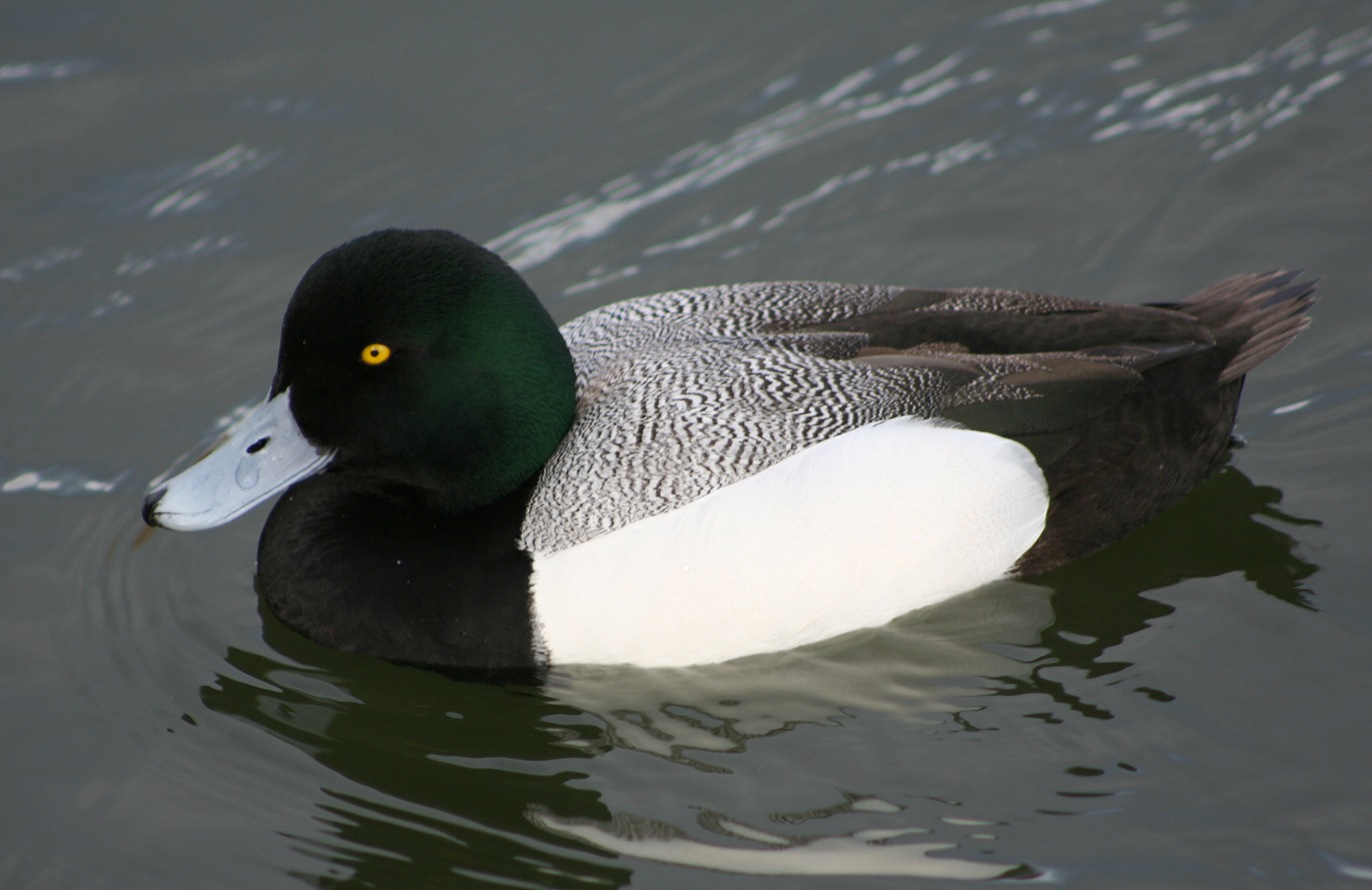
Lesser Scaup (left) and Greater Scaup (right)
Which of you did I see at Siders Pond last week, based on likelihood of being in Massachusetts?


As a middling birder who is struggling with his scaup identification, these were some of the first birds I looked up and, to tell you the truth, I still don't know which bird is more common.

In the end, this little book showed me the large amount of work that goes into planning a field guide. Differences in style have a great impact on how one identifies a bird in the field, and while reader preference will largely determine which guide is used, Mr. Tekiela's Birds of Massachusetts seems to provide most of the information the novice birder would need. For the birder who already has a shelf of bird books, this one won't take the place of any of them, but it might make a good spark book for someone else!

(photos courtesy of wikimedia)

29 January 2008

An Aid to Birdstackers

I apologize in advance for what may be a very technical post. A brand-spanking new FREE listing website is now available to birders: Birdstack. Like I said, it's new, so there may be some adjusting for new users, but I'm game. It was the first time I was able to register on a site under my own name not myownname47 or something. What I like about Birdstack is its RSS feed to your lifelist (check out my sidebar--I haven't uploaded all my sightings yet, so what's on there now is not my completed lifelist), and the fact that unlike eBird it's a worldwide listing website (not that I've ever birded out of the US, but you never know...). Things I don't like about it are the fact that you can't enter multiple birds at once and its painstaking upload process. I mean, one species at a time? really? Anyways, I don't know if anyone wants or needs this information, but here are the steps that I've found to be the least complicated to transfer sightings from eBird to Birdstack. Disclaimer: I'm not sure how this will work for everyone, I use a Mac running OS 10.2.8, I think most calculators are more advanced than my computer now. I'm lucky enough to have a copy of Microsoft Excel for Mac, otherwise I'm not sure if I could do this through AppleWorks. Update: I just checked, my AppleWorks 6.2.4 won't open the spreadsheet file from eBird. Maybe newer versions do. My apologies if I seem to spell out each little step, but in the chance that someone doesn't know "Copy" and "Paste" yet, I put that in here. Everyone's gotta learn sometime, right? Okay, here we go:

1) Sign on to eBird, and click on "My eBird". On the right-hand side, click on "Manage My Observations". All your observations should come up. If you want to show all, by all means click on "Show All". A minor point, Birdstack's RSS lifelist only goes by the observation most recently entered, apparently, NOT by the date you enter on the submission. So if you want to be anal about how your lifelist appears on an RSS feed (guilty) click on "Date" in eBird until your very first observation is on the top line, and transfer all the data chronologically.

2) Most eBird observations don't take up a lot of space, but transferring each one individually takes a lot of time, so I've been transferring one-month chunks. You can use your discretion as to how many you want to transfer. Note, there is a limit on file size once we get to the Birdstack side of things, so don't go too crazy. eBird's files tend to be ~ 4kb, or at least mine are, if you want to use that as a guide. Still on "Manage My Observations"? Go to the first one and click "View or edit". Once there, click "Download report". Repeat the downloading process for as many observations as you like. You're done with the eBird end!

3) Open up one of the downloaded reports. You'll get a spreadsheet with a bunch of columns and your recognizable data. Now we have to move the data from the other downloaded observations to this one. Open up the next report and highlight the first box under "Species" should be box A2. Drag the highlight down to the last species in column A and then to the right to either column E "Observation date" or column F "Start time" if there's anything in column F. You should have a rectangle highlighted now. Hit control-C or Apple-C or go up to the Edit menu and click on "Copy". Close this report. Go to the first report (you can keep it open in the back this whole time) and click on the first empty box in column A. Hit Control-V or Apple-V or go up to the Edit menu and click on "Paste". Repeat the copy and paste steps for each other report. At the end, you should have your first report with a lot of columns, and every other report with only the first five or six columns all on one spreadsheet.

4) Now we have to manipulate the spreadsheet into something that Birdstack will recognize. Column A "Species" needs to be renamed "English name", without the quotes, though. "Number reported" becomes "Number observed". (Thanks to drewweber on the Birdstack forums, any field with an X in it is all set to be uploaded to Birdstack now.) Skip over "Location" to "Observation type" and click on the D above it. This should highlight the whole column. Go up to Edit and click on Delete. That should move the other columns over one (E becomes D, F becomes E, etc.). New column D, "Observation date", needs to be renamed "MDY date", which stands for Month-Day-Year. Again, click on the D at the top of the column, and go up to the Format menu and click Cells (this step might be different for Windows users). A little window should pop up with a menu of items to choose from, you want "Date". A new menu, will pop up, scroll to the entry that looks like 02/28/2008, or MM/DD/YYYY, and click on it. All of the dates in that column should automatically change to that format. The next column, "Start time" needs to be changed to "12-hour time". Any entries with a "N/A" in it will have to be changed so that it's blank. Click on the word "Duration" at the top of the next column and drag down to the bottommost entry, then right to last column that has anything in it, so that you get another big rectangle. Go up to Edit and then Clear the contents. The last step to prepare the spreadsheet: go to File, then Save As, and then Format "CSV" (maybe with the phrase "comma delimited"). Hit Save, quick!

?) Phew! I forgot what number I was on. Now go to Birdstack and register, if you haven't, or sign on, if you aren't. Click "Record an observation", then "import observations in bulk". Click "upload a file" and then Browse the folder for your spreadsheet from the last step, which should end in ".csv". If everything went well, after you hit Continue your screen will say "Validate file and continue". If something's still wrong, it will give you an error in red, perhaps something like "column not recognized: start time". In that case you need to open your .csv file and change whatever the problem is. Once everything's fixed (believe me, I went through this a lot: that's why I thought I might post instructions) and validated, you'll get a list of each species on the spreadsheet. Click "Save and continue". Every recognized species is now added to your Birdstack account. If you have any species it questions (European Starling, e.g., or any eBird spuhs) it will be in green and you'll have to click on it to correct it. In the case of the starling, Birdstack recognizes a different common name, the Common Starling. In the case of any spuhs ("Lesser/Greater Scaup" or "buteo sp."), Birdstack doesn't recognize them and you'll just have to delete them. And guess what? You're done!

Again, I apologize for the length of the directions. I just tried a dry run of another month's worth of data, and it only took about five minutes. Once all the observations are in you can edit the location in Birdstack or whatever else you'd like. Of course, Birdstack is changing a lot since it's the beginning, these directions will probably be obsolete in another few hours, but I hope it helps someone.